For years, the global race for the most powerful artificial intelligence models has looked like a familiar tech competition: better algorithms, more data, bigger models. But behind the headlines about trillion-parameter systems and multimodal breakthroughs, a quieter constraint is starting to dominate the conversation. The next decisive factor in the AI race may not be code at all – it may be electricity.
As AI models grow larger and more capable, they are also becoming vastly more energy-hungry. Training and operating frontier models now requires enormous computational infrastructure, and with it, massive and reliable power supplies. This reality is beginning to reshape competitive dynamics among the world’s leading AI players. In the coming years, access to energy – not talent or data – could determine who leads and who falls behind.
The AI Arms Race: Bigger Models, Bigger Power Bills
The current generation of AI systems is built on large-scale neural networks that require specialized hardware, primarily GPUs and increasingly custom accelerators. Training a single frontier model can consume as much electricity as a small town over weeks or months. Running these models at scale – serving millions of users in real time – multiplies that demand further.
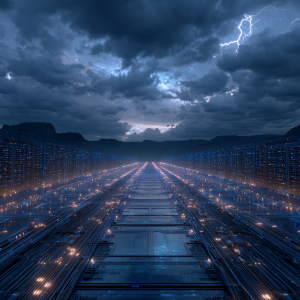
Estimates vary, but industry analysts broadly agree on the direction of travel: AI-related electricity consumption is rising at a pace that outstrips most other sectors of the digital economy. Major cloud providers and AI labs are now planning data centers with power requirements measured not in megawatts, but in hundreds of megawatts or even gigawatts.
This shift has transformed energy from a background cost into a strategic constraint.
The Major Players - And Their Energy Problem
OpenAI and Microsoft
OpenAI’s flagship models run almost entirely on Microsoft Azure infrastructure. Microsoft has acknowledged that AI is driving unprecedented growth in data center energy demand and has responded by signing long-term renewable energy contracts and investing in nuclear power partnerships. These measures are substantial, but they also reveal a vulnerability: OpenAI’s development speed is tightly coupled to Microsoft’s ability to scale power infrastructure fast enough.
Google DeepMind
Google has long positioned itself as a leader in sustainable computing. It operates some of the most energy-efficient data centers in the world and has committed to running on carbon-free energy 24/7 by 2030. Still, DeepMind’s increasingly ambitious models place pressure even on Google’s advanced infrastructure. Efficiency gains help, but they cannot fully offset the exponential growth in compute requirements.
Meta
Meta has openly admitted that AI is driving a surge in its capital expenditures. The company is building new data centers optimized for AI workloads, but it faces regulatory, environmental, and grid-capacity challenges – especially in regions where energy infrastructure is already stretched.
Anthropic and Other Labs
Smaller frontier labs often depend on cloud providers or external partners for compute. That dependence may increasingly limit how aggressively they can scale, regardless of research ambition.
Across the board, the message is the same: AI development speed is now constrained by power availability.
Electricity as a Strategic Advantage
Until recently, electricity was treated as a solvable logistics problem – buy more power, sign more contracts, build more data centers. But that assumption is breaking down.
Power grids in many regions are already under strain. Permitting new high-capacity data centers can take years. Renewable energy expansion, while accelerating, does not always align geographically or temporally with AI demand. As a result, electricity is becoming a bottleneck that cannot be bypassed simply with money.
This is where the AI race begins to intersect with energy geopolitics, infrastructure policy, and – increasingly – space technology.
Elon Musk’s Ecosystem Advantage: Visionary, But Not Yet Reality
Elon Musk occupies a unique position in this landscape. Unlike most AI leaders, Musk controls companies across multiple layers of infrastructure: xAI in artificial intelligence, Tesla in energy storage and generation, and SpaceX in space launch and satellite networks.
There is no evidence today that SpaceX satellites are powering Earth-based AI training or inference. That idea remains speculative. However, what is real is that Musk’s companies are deeply involved in technologies that could reshape future energy supply:
- SpaceX has dramatically lowered the cost of launching hardware into orbit.
- Starlink operates a vast satellite network powered by solar energy in space.
- Tesla is a leader in battery storage, grid stabilization, and renewable integration.
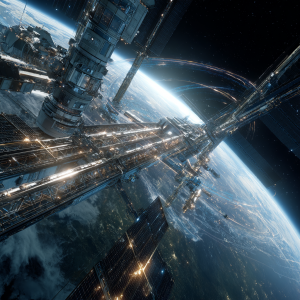
In recent industry discussions, space-based solar power and orbital data centers have emerged as long-term concepts for addressing AI’s energy demands. The logic is straightforward: in space, solar energy is constant, unobstructed by weather or night cycles. If computing could be performed in orbit — or energy transmitted efficiently back to Earth — it could bypass terrestrial grid constraints.
These ideas are not operational today. But Musk’s ecosystem gives him a structural advantage in experimenting with them faster than most competitors. If space-based energy or computing becomes viable within the next decade, Musk’s companies would be unusually well-positioned to benefit.
Jeff Bezos and Blue Origin: A Parallel Path
Jeff Bezos is often described as Musk’s quiet counterpart in space. Through Blue Origin, Bezos has invested heavily in reusable launch systems and long-term space infrastructure. Bezos has also repeatedly emphasized his vision of moving energy-intensive industry off Earth to preserve the planet.
While Blue Origin currently trails SpaceX in launch cadence, Bezos’ long-term thinking aligns closely with the emerging AI-energy dilemma. Amazon Web Services already dominates cloud infrastructure, and AI workloads are now one of its fastest-growing segments. Should space-based energy or orbital computing mature, AWS and Blue Origin could form a powerful vertically integrated stack.
As with Musk’s vision, this remains aspirational – but it is no longer science fiction. The AI industry’s energy appetite is forcing serious consideration of options once dismissed as impractical.
The Risk of a Two-Tier AI World
One of the most significant implications of AI’s electricity hunger is inequality — not among users, but among developers.
Companies with access to cheap, stable, and scalable energy will be able to train more models, run more experiments, and iterate faster. Those without it may be forced to slow development, limit model size, or rely on external providers. Over time, this could create a two-tier AI ecosystem: energy-rich giants at the frontier, and everyone else following behind.
This raises uncomfortable questions about concentration of power, innovation diversity, and long-term competition.
Efficiency Alone Won’t Save the Day
AI labs often point to efficiency improvements — better algorithms, smaller models, optimized hardware — as a solution. These gains are real and important. But history suggests they won’t be enough.
Every major efficiency breakthrough so far has been followed by even more ambitious scaling. Lower costs don’t reduce demand; they increase it. In AI, efficiency often accelerates energy consumption rather than curbing it.
That makes energy access not a temporary hurdle, but a permanent strategic concern.
Final Thoughts
The AI race is entering a new phase. The winners will still need brilliant researchers, high-quality data, and cutting-edge algorithms – but they will also need something far more basic: power.
Electricity is becoming the new compute. Infrastructure is becoming strategy. And companies that control energy generation, storage, and delivery may hold the real advantage.
Visionary ideas like space-based solar power are not solutions for today. But they are no longer distractions either. As AI continues to scale, the boundary between digital innovation and physical infrastructure will blur further.
The next breakthrough AI model may not come from the smartest lab – but from the one that never runs out of power.
Stay curious, stay informed, and let´s keep exploring the fascinating world of AI together.
This post was written with the help of different AI tools.