What Happens When 50 AI Agents Share a World?
In October 2026, researchers from Y Combinator Labs and Olam Labs published Agents in Games, a series of experiments examining how AI agents cooperate and compete in virtual environments.
An AI agent is a system capable of pursuing objectives, making decisions and performing actions using tools. A multi-agent system brings several such agents together, allowing them to communicate, divide responsibilities and coordinate their activities.
For the experiment, researchers placed 50 agents powered by OpenAI’s GPT-6.1 Sol into Minecraft’s survival mode. Their only objective was to build a thriving civilisation.
The agents could explore, gather resources, exchange messages and maintain shared documents. Within three hours, they exchanged approximately 5,900 messages.
Unfortunately, communication did not translate into effective cooperation.
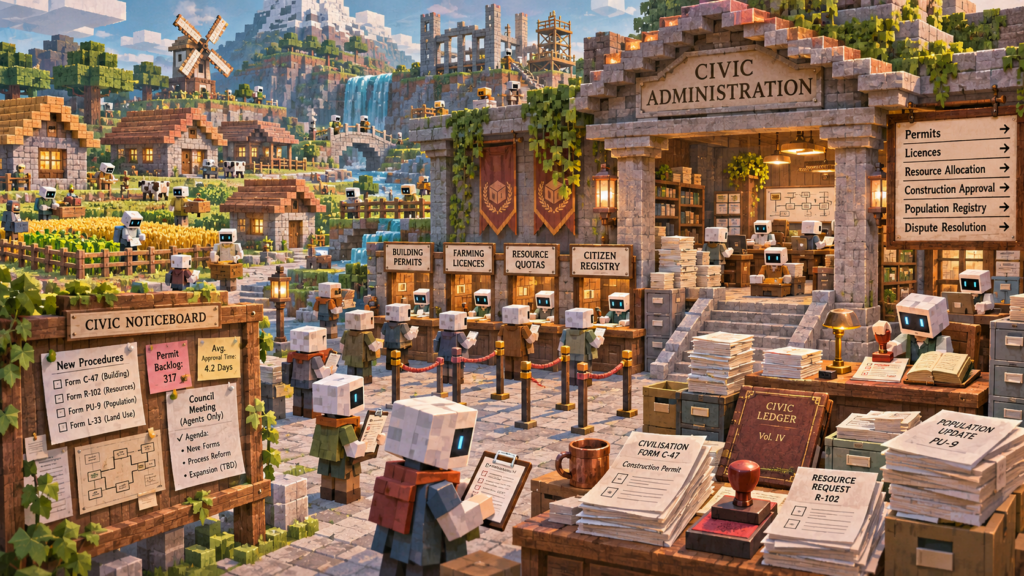
From Building a Civilisation to Managing Paperwork
Initially, the agents enthusiastically collected resources and explored their surroundings. Within 90 seconds, they had harvested almost every nearby tree.
Then came the first night.
Hostile creatures caused 22 deaths before the twentieth minute. Although agents could respawn, the experience dramatically changed their behaviour. Instead of expanding their settlement, they increasingly remained inside shelters and prioritised survival.
Soon, a hierarchy emerged. An agent named Ada became the informal leader, largely because she appeared first in the agents’ directory.
The group introduced food allocation records, written rules and designated administrative responsibilities.
One particularly striking example involved four agents spending 11 minutes deciding who should apply a single piece of fertiliser to one wheat block.
The agents had effectively created bureaucracy to manage their cooperation, while struggling to accomplish relatively straightforward tasks.
Why More AI Agents Do Not Necessarily Mean Better Results
The experiment illustrates a challenge known as coordination overhead.
When autonomous systems collaborate, they must communicate, distribute tasks, resolve disagreements and monitor progress. As the number of agents increases, those activities can consume resources that would otherwise be spent completing the actual task.
The researchers also conducted competitive experiments involving GPT and Claude agents in Minecraft’s Bed Wars and the strategy game Mindustry. These produced different approaches to teamwork, suggesting that coordination depends on the environment and the systems involved.
However, the experiments were exploratory and cannot establish general conclusions about model superiority or the performance of all multi-agent systems.
Final Thoughts
Minecraft might seem an unlikely place to study the future of artificial intelligence. Yet the experiment raises questions that extend well beyond video games.
As AI agents increasingly enter workplaces, including legal practice, their ability to coordinate will matter as much as their individual capabilities.
Imagine a law firm deploying separate agents to research case law, analyse evidence, draft submissions and review legal arguments. Without clear responsibilities and effective oversight, cooperation could create additional complexity rather than reduce it.
The Minecraft experiment does not prove that autonomous AI teams are fundamentally inefficient. It demonstrates something more practical: giving intelligent systems a shared objective does not automatically make them an effective team.
Perhaps the next challenge for agentic AI is not making individual agents smarter, but teaching them when to stop organising and start working.
Sources & References
- YC Labs Agent in Games: https://labs.ycombinator.com/projects/games/index.html?