What Is the EU AI Act?
The EU AI Act, officially Regulation (EU) 2024/1689, establishes a common legal framework for artificial intelligence across the European Union.
Its objective is to encourage the development and use of trustworthy AI while protecting health, safety and fundamental rights.
Rather than regulating every AI application identically, the legislation introduces a risk-based approach. The legal requirements depend primarily on the system’s intended purpose and potential risks.
The Act also distinguishes between different responsibilities, particularly those of providers, who develop or place AI systems on the market, and deployers, who use them professionally.
Its scope can extend to organisations outside the EU, including providers whose AI outputs are used within the Union.
How Does the EU AI Act Classify AI Systems?
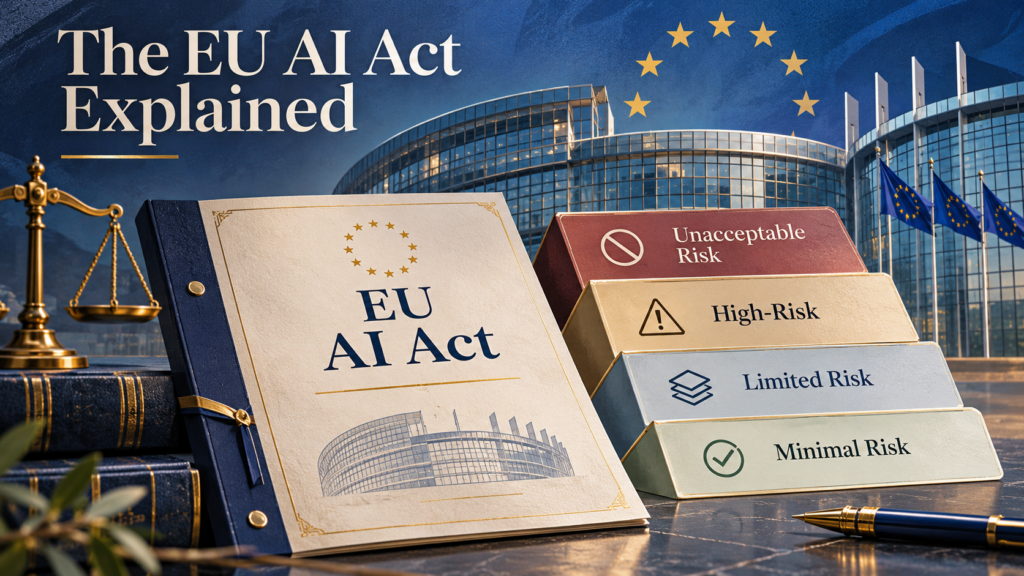
The Act distinguishes between four broad levels of risk.
Unacceptable risk: Certain AI practices are prohibited, including specified forms of manipulative AI, social scoring and certain uses of biometric identification. These prohibitions are subject to precisely defined legal conditions and exceptions.
High risk: Systems used in sensitive areas, such as recruitment, education, law enforcement or the administration of justice, may be classified as high-risk. They face requirements concerning risk management, data governance, documentation, transparency, human oversight and technical robustness.
Transparency risk: Certain systems, including chatbots and applications generating deepfakes, are subject to disclosure or transparency obligations.
Minimal or no risk: Applications such as ordinary spam filters generally face no additional system-specific requirements under the AI Act.
Importantly, not every application of AI in a sensitive sector automatically qualifies as high-risk. The statutory classification criteria remain decisive.
What About ChatGPT and Generative AI?
The AI Act also introduces specific rules for general-purpose AI models, which can perform a wide range of tasks.
Providers of these models must meet obligations concerning technical documentation, copyright compliance and information about training content. Models presenting systemic risks are subject to additional requirements, including risk assessment and mitigation.
The legislation therefore regulates not only particular AI applications but also certain underlying models on which those applications depend.
When Does the EU AI Act Apply?
The AI Act entered into force on 1 August 2024, with its provisions becoming applicable in stages.
The initial prohibitions applied from February 2025, followed by rules for general-purpose AI models in August 2025. Most remaining provisions, including important transparency requirements, became applicable in August 2026.
Following the 2026 AI Omnibus amendments, the principal high-risk obligations will apply from December 2027 for systems covered by Annex III and August 2028 for systems covered by Annex I.
Final Thoughts
The EU AI Act represents an attempt to regulate artificial intelligence according to the risks it creates rather than the technology alone.
Yet establishing legal requirements is only the beginning. Their effectiveness will depend on how consistently authorities enforce them and how successfully organisations translate abstract obligations into practical safeguards.
Ultimately, the challenge is finding a regulatory balance that protects fundamental rights without unnecessarily restricting technological innovation.
Sources & References
- EU AI Act: https://eur-lex.europa.eu/TodayOJ/index.html?uri=OJ:L_202401689
- European Commission on the AI Act: https://digital-strategy.ec.europa.eu/en/policies/regulatory-framework-ai?
- European Commission on the AI Act Timeline: https://ai-act-service-desk.ec.europa.eu/en/ai-act/eu-ai-act-implementation-timeline?