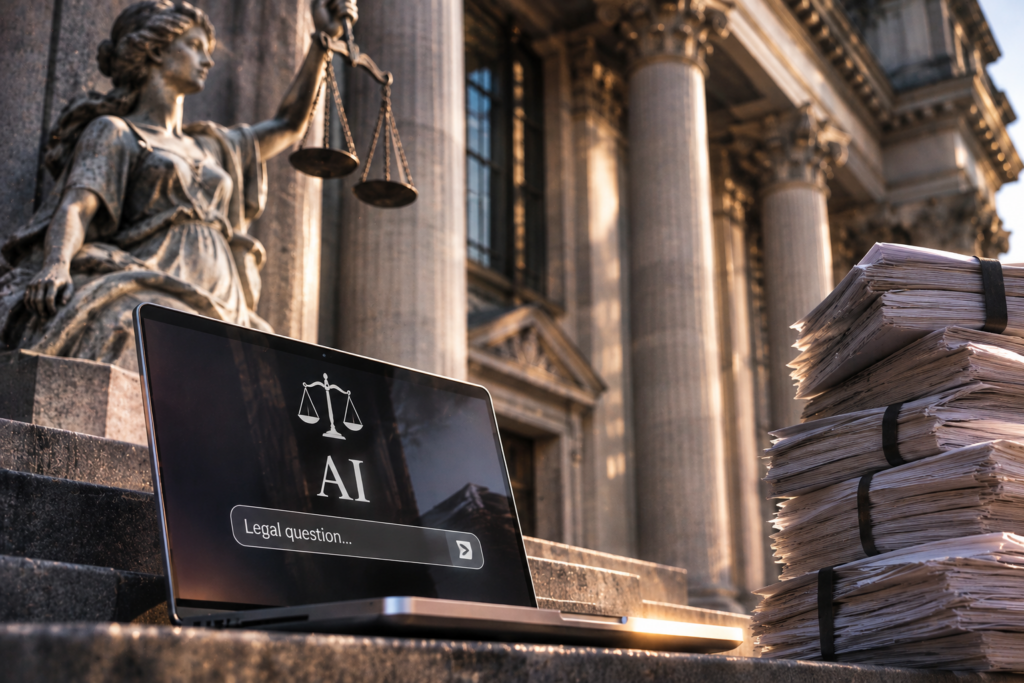
AI-Generated Lawsuits Are Reaching German Courts
According to a report published by WELT on 5 November 2026, judges in Hesse are observing growing numbers of legal submissions apparently written with AI tools such as ChatGPT, Gemini and Claude.
Social courts are particularly affected. These courts handle disputes involving social benefits, pensions and other social security matters. Under Section 73 of Germany’s Social Courts Act (Sozialgerichtsgesetz, SGG), individuals can generally represent themselves before social courts without hiring a lawyer.
Julia Pfeffer, a representative of the Hessian Association of Judges, has warned that AI-generated submissions can be unnecessarily extensive, contain questionable legal arguments and encourage applications for urgent judicial relief with little prospect of success.
The workload is already substantial. Nationwide, more than 263,500 cases were filed with Germany’s social courts in 2025, approximately 10% more than the previous year. Urgent proceedings reportedly increased by 47% to almost 40,000.
But correlation is not causation. The Hessian Ministry of Justice does not systematically record AI-generated filings. Consequently, the available figures do not establish that AI caused the increase in proceedings.
Easier Access Does Not Mean Better Legal Arguments
AI could make legal proceedings more accessible, particularly for people who cannot afford professional legal assistance or struggle to understand legal terminology.
A chatbot can help users organise facts, understand procedural requirements and prepare an initial draft. Yet producing a convincing-looking legal document is not equivalent to making a legally sound argument.
Under Section 92 SGG, a claim must identify the parties and the subject matter of the dispute. A detailed legal essay is not necessarily required. What matters is presenting the relevant facts and identifying the legal remedy sought.
The problem becomes more serious when AI invents judicial decisions, misinterprets legal provisions or recommends unsuitable procedures. Urgent applications under Section 86b SGG, for example, require specific legal conditions that cannot be satisfied simply by drafting an elaborate submission.
An AI-generated lawsuit may therefore look professional while remaining legally unsuccessful.
Can the Courts Fight AI With AI?
Hesse is also introducing AI-assisted tools within its justice system. According to Justice Minister Christian Heinz, applications include document anonymisation, administrative assistance and the processing of large volumes of information.
These technologies could reduce repetitive work. However, judicial decision-making remains the responsibility of judges, who must independently examine the facts and applicable law.
That distinction matters. Technology may help courts process information faster, but efficiency cannot replace legal scrutiny or procedural fairness.
Final Thoughts
AI has the potential to remove genuine barriers to justice. But there is a difference between giving someone the tools to file a lawsuit and helping them understand whether they have a viable claim.
If poorly drafted submissions consume judicial resources without improving legal outcomes, easier access could ultimately contribute to longer proceedings for everyone.
The more important question may therefore be not how many lawsuits AI can produce, but how effectively it can help people recognise their rights, understand their options and pursue claims that actually have merit.
Access to justice should be measured by meaningful legal protection, not simply the number of documents submitted to court.
Sources & References
- Welt article: https://www.welt.de/regionales/hessen/article6aebf916eca9cecdd5d47329/ki-erleichtert-rechtsweg-und-erhoeht-zahl-der-sozialklagen.html?
- LTO article: https://www.lto.de/recht/justiz/j/sozialgerichte-hessen-justiz-ki-flut-schriftsaetze-software-hilfe?
- Bilanz 2026 HessMin of Justice: https://it-stelle.justiz.hessen.de/handeln/halbzeitbilanz-2026/hessisches-ministerium-der-justiz-und-fuer-den-rechtsstaat?