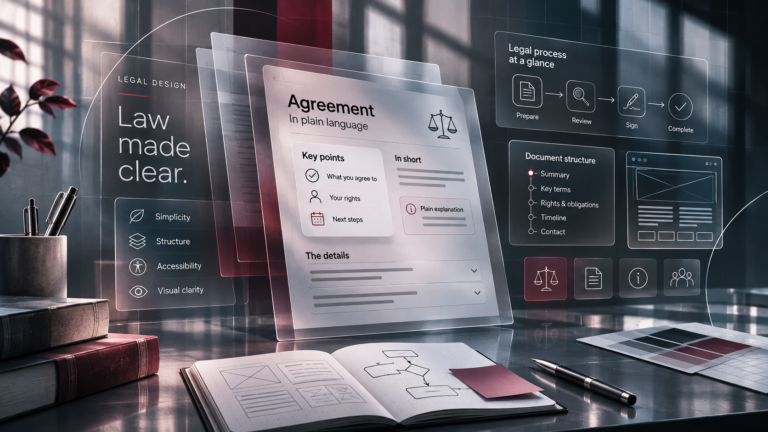
What Is Legal Design?
Legal Design is an interdisciplinary approach that combines law, design and technology to make legal information, services and systems more accessible, understandable and user-friendly.
At its core lies a shift in perspective. Instead of developing legal documents and services primarily from a lawyer’s point of view, Legal Design considers the needs, experiences and challenges of the people who actually use them.
This goes far beyond making contracts visually appealing. It involves reconsidering how legal information is communicated, how legal processes are structured and how people interact with the legal system.
Design Thinking Meets Law
One of the central methodologies behind Legal Design is Design Thinking, a human-centred approach to problem-solving.
Rather than immediately developing a solution, Design Thinking begins by understanding the needs of the intended users. This involves identifying problems, exploring potential solutions, developing prototypes and testing them with real users.
Applied to law, this might mean asking employees where they struggle to understand internal compliance policies or observing how individuals navigate court procedures.
The resulting insights can then be used to develop and refine legal documents, digital applications or entire services. The process is iterative, allowing solutions to evolve based on feedback rather than assumptions.
What Does Legal Design Look Like in Practice?
Imagine a traditional employment contract consisting of several pages of dense legal language. A Legal Design approach could transform it through clearer wording, intuitive headings, visual explanations and timelines illustrating important obligations and deadlines.
Privacy notices could use layered information and meaningful icons to help individuals understand how their personal data is collected and processed. Similarly, court forms could be redesigned to guide individuals through legal procedures using clearer instructions and accessible language.
However, simplification must never come at the expense of legal accuracy. A beautifully designed contract that misrepresents the parties’ obligations is hardly an improvement.
Legal Design and Access to Justice
Perhaps the most compelling aspect of Legal Design is its potential to improve access to justice.
Understanding one’s rights is an important step towards exercising them. By reducing unnecessary complexity and making legal services easier to navigate, Legal Design can help lower barriers between individuals and the legal system.
Technology, including artificial intelligence, can support this development through interactive legal guidance, personalised information and digital self-service tools. However, accessibility also requires considering people who lack digital skills or access to technology.
Final Thoughts
Legal Design challenges a deeply rooted assumption within the legal profession: that complexity is an inevitable companion of legal expertise.
Making law understandable does not mean making it less sophisticated. It means communicating its complexity more effectively.
Perhaps the real measure of a well-designed legal system is not how impressive it appears to legal professionals, but how well it works for the people it is intended to serve.