Behind the Article:
Last December, I wanted to write an article about the factors that might eventually limit the development of artificial intelligence. I initially expected to find answers related to computing power, technological capabilities or the availability of training data. Instead, during my research, I repeatedly came across the same resource: electricity.
That led me down a rather unexpected rabbit hole, from nuclear power plants and data centres to Elon Musk, SpaceX and the commercial potential of outer space.
I also began to ask myself a question that had fascinated me for some time: why are some of the wealthiest people in the world investing billions in space exploration? Their publicly stated ambitions often revolve around the future of humanity, scientific progress and the preservation of our planet. But what if there is also an extraordinary economic opportunity behind these ambitions?
Recent developments at SpaceX make this question more interesting than ever.
Electricity: The Next Bottleneck in Artificial Intelligence
Much of the public debate surrounding artificial intelligence focuses on the capabilities of large language models. Which chatbot performs best? Which company develops the most advanced reasoning model? How close are we to artificial general intelligence?
Behind these developments lies a considerably less glamorous reality: artificial intelligence requires enormous physical infrastructure.
Training and operating AI models requires specialised processors, data centres, cooling systems and reliable electricity supplies. And as AI becomes increasingly integrated into our everyday lives, the demand for these resources could continue to grow.
According to the International Energy Agency’s 2025 report Energy and AI, global electricity consumption by data centres could more than double between 2024 and 2030, reaching approximately 945 terawatt-hours annually. Artificial intelligence is expected to be the primary driver of this growth, alongside other digital services.¹
Technology companies are already responding.
In September 2024, Microsoft entered into a 20-year electricity purchase agreement with Constellation Energy, supporting the planned reopening of a nuclear reactor at Three Mile Island in Pennsylvania.² Google has entered into an agreement with Kairos Power to support the development of small modular nuclear reactors.³ Amazon has also invested in nuclear energy projects.⁴
These companies are increasingly treating energy supply as a strategic business consideration rather than simply an operational expense.
Elon Musk, however, is exploring an alternative that could fundamentally change where artificial intelligence operates.
Elon Musk's Ecosystem: Connecting the Dots
When we think about Elon Musk, we often think about his companies individually. Tesla produces electric vehicles, SpaceX launches rockets, Starlink provides satellite internet and xAI develops artificial intelligence.
What fascinated me during my research was looking at these businesses not as isolated ventures, but as potentially complementary components of a much larger infrastructure.
SpaceX provides access to space.
Through Falcon 9 and the ongoing development of Starship, SpaceX is pursuing increasingly reusable space transportation.⁵ If launch vehicles can be recovered, refurbished and relaunched efficiently, the cost of transporting equipment into orbit could fall substantially.
This would be particularly important for orbital data centres, which would require the transportation of considerable quantities of hardware, solar panels and cooling equipment into space.
Starlink provides satellite infrastructure and connectivity.
SpaceX already operates an extensive satellite communications network through Starlink. Its satellites generate electricity using solar panels and communicate through a combination of ground infrastructure and optical inter-satellite links.⁶
This gives SpaceX practical experience in manufacturing, deploying and operating satellites at scale. These capabilities could also be valuable when developing networks of computing satellites.
Tesla provides energy storage and energy management technologies.
Tesla is frequently associated with electric vehicles, but its energy business is particularly interesting in this context. Its Megapack systems provide large-scale battery storage, helping manage fluctuations in electricity generation and consumption.⁷
And the relationship between Tesla and SpaceX is no longer purely theoretical.
According to Tesla’s quarterly report for the period ending 30 September 2026, the company recognised $626 million in revenue from Megapack sales to SpaceX during the first nine months of 2026.
Tesla also disclosed a $2 billion investment in SpaceX following regulatory approvals in March 2026, representing an ownership interest of less than 1%.⁸
These transactions do not establish that Tesla’s batteries will eventually power orbital data centres. They do, however, demonstrate that commercial and financial connections between Musk’s businesses are already developing.
xAI provides artificial intelligence and computing demand.
Founded in 2023, xAI develops the Grok family of AI models and operates large-scale computing infrastructure.⁹
On 2 February 2026, SpaceX announced that it had acquired xAI. In its announcement, the company explicitly connected artificial intelligence, reusable rockets, satellite communications and the development of space-based computing infrastructure.¹⁰
This is perhaps the clearest indication that the relationship between these technologies is more than an interesting coincidence.
Of course, these businesses do not collectively control every component required for artificial intelligence. They remain dependent on semiconductor manufacturers, suppliers, external capital and regulatory authorities. Tesla also remains a legally separate company.
Nevertheless, the potential for vertical integration is remarkable.
Where other companies may need to purchase electricity, rent computing capacity, contract satellite manufacturers and rely on external launch providers, Musk’s business ecosystem could potentially cover several of these infrastructure layers itself.
Why SpaceX's Latest Achievement Matters
On 14 November 2026, SpaceX achieved a significant milestone. For the first time, the Starship upper stage returned from orbit and was caught by the mechanical arms of its launch tower in Texas.
The mission was not a complete success. The Super Heavy booster failed to return as planned, meaning that SpaceX has yet to demonstrate the recovery of both stages during the same flight.¹¹
Nevertheless, the successful recovery of the upper stage represents an important step towards the company’s ambition of developing a fully reusable launch system.
Why does this matter for artificial intelligence?
Because one of the greatest barriers to building large-scale infrastructure in space is the cost of getting it there.
Reusable rockets could potentially transform the economics of space transportation. If launches become sufficiently inexpensive and frequent, projects that are currently commercially unrealistic could become viable.
This would have implications far beyond scientific exploration or missions to Mars.
An affordable transportation system could enable the construction of industrial infrastructure in orbit, including solar power installations and data centres.
And SpaceX appears to be preparing for precisely that possibility.
On 10 November 2026, the German engineering company Singulus Technologies announced a contract with SpaceX worth more than €60 million for its first advanced solar cell manufacturing production line.
The agreement forms part of a broader partnership intended to expand SpaceX’s solar manufacturing capabilities. According to Singulus, the technology will support the production of solar cells for SpaceX’s planned Starmind satellites.
The first production line is scheduled for delivery in the first half of 2027.¹²
This does not mean that SpaceX has already solved the problem of space-based energy generation. But it demonstrates that the company is committing tangible financial resources to the industrial infrastructure required for its plans.
Could the Sun Power Artificial Intelligence from Space?
The concept of space-based solar power is considerably older than the current AI revolution.
The basic idea involves placing large solar installations in space, where they can collect sunlight without atmospheric interference and, in suitable orbits, with almost continuous exposure to the Sun.
Traditionally, researchers have explored ways to transmit the collected energy back to Earth using technologies such as microwaves or lasers.¹³
In 2023, researchers at the California Institute of Technology demonstrated wireless power transmission in space and detected a small transmitted signal on Earth through their Space Solar Power Demonstrator.¹⁴
However, this was a proof of concept rather than a commercially viable electricity supply. Significant challenges remain, including energy conversion losses, transmission efficiency, infrastructure costs and the construction of large orbital installations.
NASA’s 2024 assessment of space-based solar power likewise identified substantial economic and technological obstacles.¹⁵
But artificial intelligence introduces another possibility.
Instead of generating electricity in space and transmitting it back to Earth, why not move the electricity-consuming infrastructure itself into space?
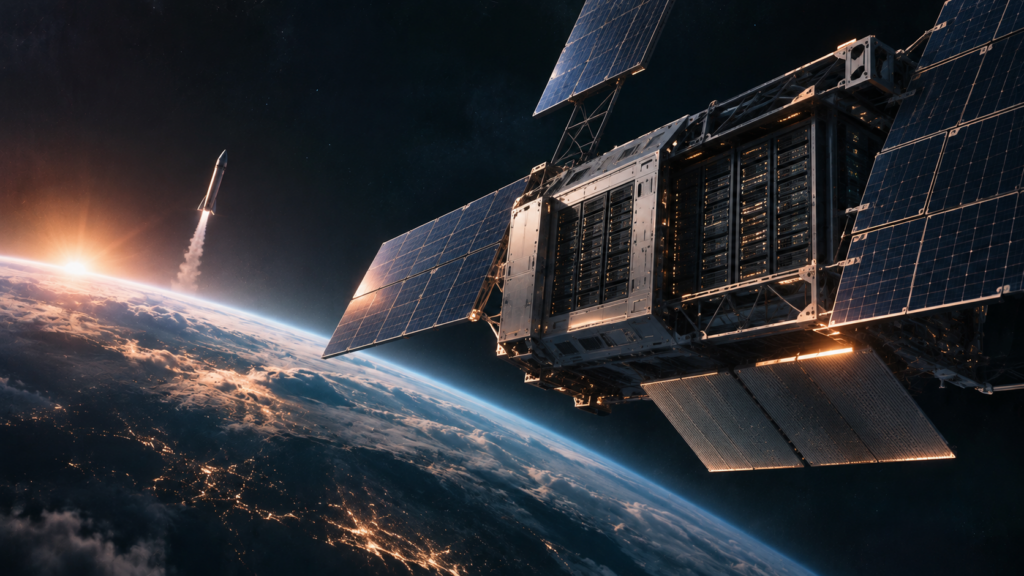
This is the concept behind orbital data centres.
Solar-powered satellites could host computing hardware, process information in orbit and transmit the resulting data back to Earth.
SpaceX has already taken preliminary regulatory steps towards this vision. In February 2026, the US Federal Communications Commission published notice of the company’s application to deploy and operate a network of up to one million satellites intended to function as orbital data centres.¹⁶
An application of this scale is not evidence that such a constellation will be constructed or that its technical and economic challenges have been resolved. Nevertheless, it illustrates the magnitude of SpaceX’s ambitions.
And Musk is not alone.
Google’s Project Suncatcher, announced in November 2025, is investigating whether interconnected, solar-powered satellites equipped with specialised AI processors could eventually provide scalable computing infrastructure.
Google’s researchers suggest that, in suitable orbits, solar panels could generate substantially more energy over time than comparable installations on Earth.¹⁷
However, space also introduces its own difficulties. Unlike on Earth, heat cannot be dissipated through surrounding air. Computing equipment must be protected against radiation, while maintenance, hardware replacement and communication between satellites present additional challenges.¹⁸
The availability of sunlight alone does not make orbital computing economically competitive.
The Billionaire Space Race: Is There a Bigger Economic Opportunity?
This brings me back to the question I asked myself last December.
Why are billionaires investing so heavily in space?
Elon Musk has long presented SpaceX’s ultimate mission as making humanity a multiplanetary species.¹⁹ Jeff Bezos has articulated a different vision through Blue Origin: moving resource-intensive activities into space to help preserve Earth.²⁰
These ambitions are not necessarily incompatible with commercial interests.
In fact, the growing demand for artificial intelligence may be creating an economic incentive to develop technologies that previously appeared relevant primarily to long-term space exploration.
Jeff Bezos’s Blue Origin is now pursuing its own orbital computing initiative, Project Sunrise.
In March 2026, the company submitted an application to the US Federal Communications Commission for a constellation of up to 51,600 satellites designed to operate as data centres in space.²¹
Bezos also founded Amazon, whose cloud computing division, Amazon Web Services, is already a major provider of digital infrastructure. Amazon has independently developed its own satellite internet initiative.²²
The potential connections between space transportation, satellite communications and computing infrastructure are therefore not exclusive to Musk.
However, Amazon and Blue Origin are separate businesses, and Bezos’s association with both does not establish that they operate as a unified enterprise or will necessarily collaborate on orbital computing.
What distinguishes Musk’s position is the extent to which several elements have already been brought together through ownership structures, commercial transactions and publicly announced corporate strategies.
SpaceX’s acquisition of xAI, Tesla’s energy infrastructure sales to SpaceX and the development of Starlink make this particularly visible.
There is no evidence that orbital data centres were the original motivation behind the foundation of SpaceX or Blue Origin. Both companies were established long before the current generative AI boom.
Nevertheless, the commercial potential of space is becoming increasingly difficult to ignore.
If orbital computing eventually offers cheaper or more scalable access to computing power, the companies capable of providing that infrastructure could occupy an enormously valuable position within the global technology industry.
The business opportunity would extend beyond selling AI products. It could include supplying the computing capacity, energy systems, transportation services and communications infrastructure upon which countless other businesses depend.
Who Will Control the Infrastructure of Tomorrow?
As someone interested in the intersection of law and technology, I find the implications of this development particularly intriguing.
Vertical integration can create considerable efficiencies. Companies that operate several interconnected stages of a supply chain may reduce costs, coordinate development more effectively and accelerate innovation.
However, the concentration of critical infrastructure also raises questions about competition and economic dependency.²³
Imagine a future in which a single corporate ecosystem operates the rockets required to launch computing infrastructure, manufactures the satellites hosting that infrastructure, provides their connectivity and develops AI services that depend on them.
Would competing AI developers have access to comparable infrastructure? On what commercial terms? Could infrastructure providers favour their own downstream services?
These questions are not entirely new. Similar issues already arise in cloud computing, digital platforms and semiconductor markets.
Moving critical infrastructure into space could add another layer of complexity, involving international space law, orbital resources, telecommunications regulation and national security.
Article VI of the 1967 Outer Space Treaty establishes that states bear international responsibility for national activities in outer space, including activities conducted by private companies. Such activities require authorisation and continuing supervision.²⁴
The development of private orbital infrastructure would therefore not take place in a legal vacuum.
Nevertheless, existing regulatory frameworks may face considerable challenges if access to computing infrastructure increasingly depends on privately operated space-based systems.
Final Thoughts
I began researching this topic because I wanted to understand what might eventually limit the development of artificial intelligence.
What I found was a much broader question about the relationship between technology, energy, infrastructure and economic power.
Perhaps electricity will become one of the greatest constraints on AI development. Perhaps more efficient models, improved hardware and advances in terrestrial energy generation will prove sufficient. Or perhaps some of the infrastructure required to sustain artificial intelligence will eventually move beyond Earth.
At this stage, nobody can reliably predict which scenario will prevail.
But what fascinates me about the developments surrounding Elon Musk is the possibility that companies which initially appeared to pursue entirely different objectives could eventually become components of the same technological ecosystem.
Whether this reflects a long-standing strategic vision or an emerging opportunity created by the AI revolution remains an open question.
Either way, it might be worth paying a little less attention to which company currently has the smartest chatbot and a little more attention to who is building the infrastructure that will power the next generation of artificial intelligence.
Because the future of AI may ultimately be determined not only by who develops the most powerful models, but by who controls the resources that make them possible.
Sources & References
1 International Energy Agency: Energy and AI (2025), Executive Summary
2 Constellation Energy (2024). Constellation to Launch Crane Clean Energy Center.
3 Google & Kairos Power (2024). Agreement to Deploy 500 MW of Clean Electricity Generation.
4 Amazon (2024). Agreements for Innovative Nuclear Energy Projects.
5 SpaceX. Mission and Reusability.
6 Starlink. Satellite Technology and Connectivity.
7 Tesla. Megapack – Large-Scale Energy Storage.
8 Tesla (2026). Quarterly Report, Form 10-Q, 30 September 2026, Note 13 – Related Party Transactions.
9 xAI. Company, AI Models and Computing Infrastructure.
10 SpaceX (2026). Quarterly Report – Acquisition of xAI.
13 NASA (2024). Space-Based Solar Power.
15 NASA (2024). Space-Based Solar Power – Economic and Technological Feasibility Assessment.
19 SpaceX. Mission – Making Humanity Multiplanetary.
22Amazon. Amazon Leo – Satellite Internet Infrastructure.
24 United Nations (1967). Outer Space Treaty, Article VI.
25 International Energy Agency (2026). Key Questions on Energy and AI.