The Hidden Problem Behind Correct Legal Answers
Artificial intelligence has become increasingly capable of answering legal questions, analysing documents and supporting legal research. As these systems improve, their performance is frequently measured through benchmarks that compare AI-generated answers with predefined correct responses.
The logic seems straightforward: the more correct answers a model produces, the more reliable it appears.
But legal practice rarely works that way.
Consider a lawyer advising a client on whether a claim is time-barred. Identifying the correct limitation period is only part of the task. The lawyer must also establish which legal provisions apply, whether the period has started, whether any suspension or interruption rules are relevant and how those rules interact with the facts.
A correct conclusion reached through an incorrect interpretation of the law would hardly constitute satisfactory legal advice.
Yet traditional AI evaluations can overlook precisely this distinction.
In September 2026, researchers Yujin Zhou and colleagues introduced LexAgentHallu, a benchmark designed to examine not only whether legal AI systems reach the correct answer, but also how errors arise during their work.
The study was subsequently published in the proceedings of the 2026 Conference on Empirical Methods in Natural Language Processing (EMNLP).
Its central finding is particularly relevant for the legal profession: AI systems can arrive at correct legal conclusions while relying on flawed intermediate steps.
Inside the Study: 3,414 Cases and 18 AI Agents
The researchers evaluated 18 proprietary and open-source AI agents using a benchmark containing 3,414 instances across 17 legal categories and six task types.
Unlike a conventional chatbot that responds to a single question, an AI agent may perform several interconnected operations. It can plan a research task, retrieve legal information, consult external tools, analyse the results and formulate an answer.
This creates additional opportunities for mistakes. A system might retrieve an irrelevant authority, misunderstand a legal principle or introduce an unsupported factual assumption. Each error can influence subsequent stages of the process.
To investigate these problems, the researchers developed a detailed classification system covering seven broad categories and 27 more specific types of hallucinations. Their approach distinguishes between two important dimensions.
The first concerns substantive legal errors, such as fabricated authorities, incorrect legal propositions or mistakes in applying rules to facts.
The second concerns failures in the agent’s working process, including problems with retrieving, selecting or using information.
This distinction matters because a legal AI system may know the relevant legal principle but still fail to use its tools appropriately. Conversely, it may retrieve appropriate material and then misinterpret its significance.
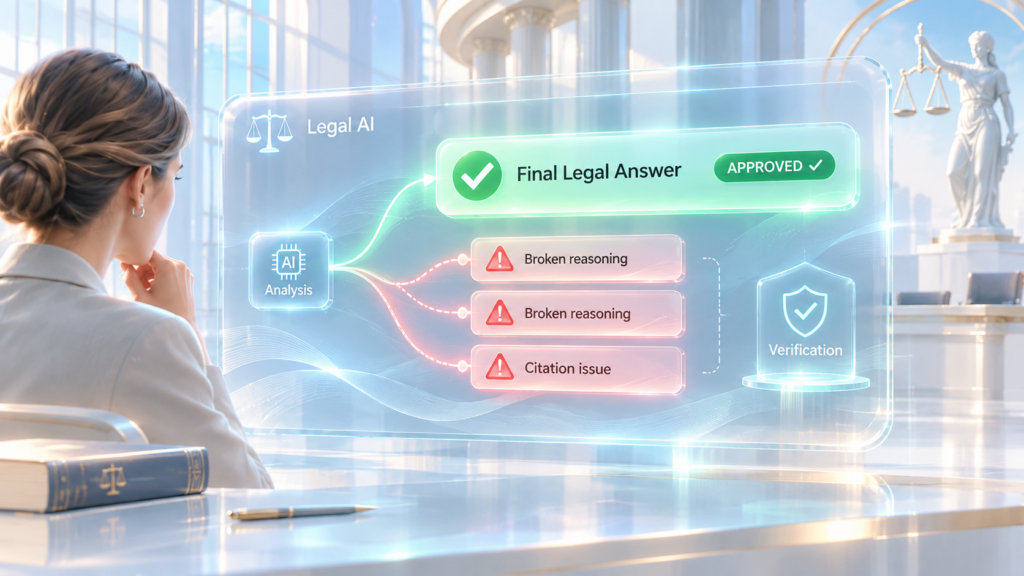
The benchmark therefore examines the agent’s recorded execution path rather than relying exclusively on the final response.
The Right-Answer-Wrong-Reason Effect
One of the study’s most revealing findings is what the researchers call the Right-Answer-Wrong-Reason effect.
The concept describes situations in which an AI system produces a correct final answer despite hallucinations appearing in the intermediate process.
The researchers specifically measured how often correct answers coexisted with different categories of errors.
Their reported average for substantive legal hallucinations was approximately 68% among correct-answer trajectories. This does not mean that 68% of all legal AI answers were wrong. Rather, it indicates that, within the evaluated benchmark and systems, a correct outcome frequently concealed substantive problems in the recorded process.
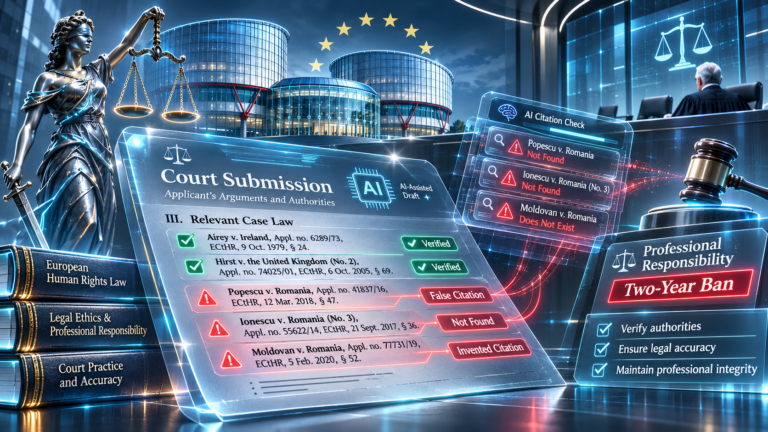
Consider a simplified hypothetical example: An AI assistant is asked whether a claim can be brought before a particular court. It correctly identifies the competent court but supports its conclusion with a judgment that concerns a different procedural issue. A benchmark assessing only the final answer might consider the response successful. A practising lawyer, however, would recognise that the supporting reasoning is unreliable.
The problem becomes even more serious when the output is incorporated into a legal memorandum or court submission. A false citation or misapplied authority may go unnoticed precisely because the final conclusion appears plausible.
The researchers also found that hallucinations were not distributed randomly. Different agent configurations, legal tasks and categories displayed distinct patterns of errors. This suggests that evaluating legal AI requires more than assigning a single accuracy score. Developers need to understand which kinds of failures occur, where they originate and how they affect the finished work.
Why Legal Reasoning Is Different From Getting the Answer Right
The distinction between outcomes and reasoning is particularly important in law.
Legal conclusions must be supported by identifiable sources, defensible interpretations and a coherent application of rules to facts.
Two lawyers may reach the same conclusion while relying on different arguments. That does not necessarily mean one is wrong. Legal interpretation often involves legitimate disagreement.
But there is a fundamental difference between competing legal interpretations and a conclusion based on a fabricated judgment or an invented statutory requirement.
The latter cannot become reliable simply because the answer happens to be correct.
This is also why the study should not be interpreted as proving that an AI model’s internal reasoning has been fully revealed.
The researchers examine observable intermediate outputs and tool interactions. These provide valuable information about how an agent operates, but they do not necessarily disclose the complete internal computational process of the underlying language model.
Nevertheless, the practical implications are substantial.
If a legal AI system provides an accurate conclusion supported by unreliable material, users may develop misplaced confidence in its abilities.
And the more convincing its language becomes, the easier it may be to overlook the errors beneath the surface.
For junior lawyers in particular, this creates an additional challenge: evaluating AI-generated research requires precisely the legal knowledge and professional judgement that they are still developing.
What Does This Mean for Lawyers and Legal Tech?
For legal professionals, the study reinforces an essential distinction between using AI as a research assistant and relying on it as an independent source of legal authority.
An AI-generated citation must be checked against the original decision. A statutory interpretation must be assessed against the applicable legislation. And a persuasive legal argument must still withstand independent scrutiny. But the responsibility should not rest exclusively with individual users. Legal-Tech developers also face the challenge of designing systems that make verification easier rather than merely producing more convincing answers.
This could include direct access to primary legal sources, transparent references to retrieved material, mechanisms for identifying unsupported claims and evaluation procedures that assess intermediate steps.
Such measures would not eliminate hallucinations. They could, however, make them easier to detect before they influence legal advice or litigation.
The findings also have implications for the procurement and assessment of legal AI products. A tool that achieves an impressive accuracy score on legal questions may still exhibit significant weaknesses in source selection, citation reliability or the application of legal rules.
Law firms therefore have good reason to ask not only how often a system produces the correct answer, but also whether its supporting evidence is verifiable.
Importantly, LexAgentHallu does not establish the real-world error rate of every commercial legal AI product. It evaluates particular agents and tasks under benchmark conditions. Its findings identify weaknesses that deserve attention, not universal failure rates across the legal profession.
Final Thoughts
For lawyers, reaching the correct conclusion has never been the only requirement of good legal work.
The reasoning matters because it allows clients, colleagues and courts to understand, challenge and verify a legal assessment.
Artificial intelligence should not be held to a lower standard simply because its answers are generated faster.
The LexAgentHallu study demonstrates why conventional measures of AI performance can provide an incomplete picture of reliability. A correct answer may reflect sound research and analysis, but it may also conceal errors that become visible only when the supporting process is examined.
As legal AI systems become more autonomous, that distinction will become increasingly important.
The challenge is not merely to build systems that produce accurate legal conclusions. It is to develop tools whose supporting arguments and sources can withstand the same critical scrutiny expected of human legal professionals.
Because in law, being right matters. But being able to explain why may matter just as much.
Sources & References
LexAgentHallu: A Hierarchical Benchmark for Profiling Hallucinations in Legal Agents
Yujin Zhou et al. (2026), Proceedings of the 2026 Conference on Empirical Methods in Natural Language Processing, pp. 48241–48269. DOI: 10.18653/2026.emnlp-main.2121.
- LexAgentHallu – arXiv Preprint
- Hallucination-Free? Assessing the Reliability of Leading AI Legal Research Tools
- ai-legalinsight.com: What is Automated Decision-Making?