When AI Invents Case Law
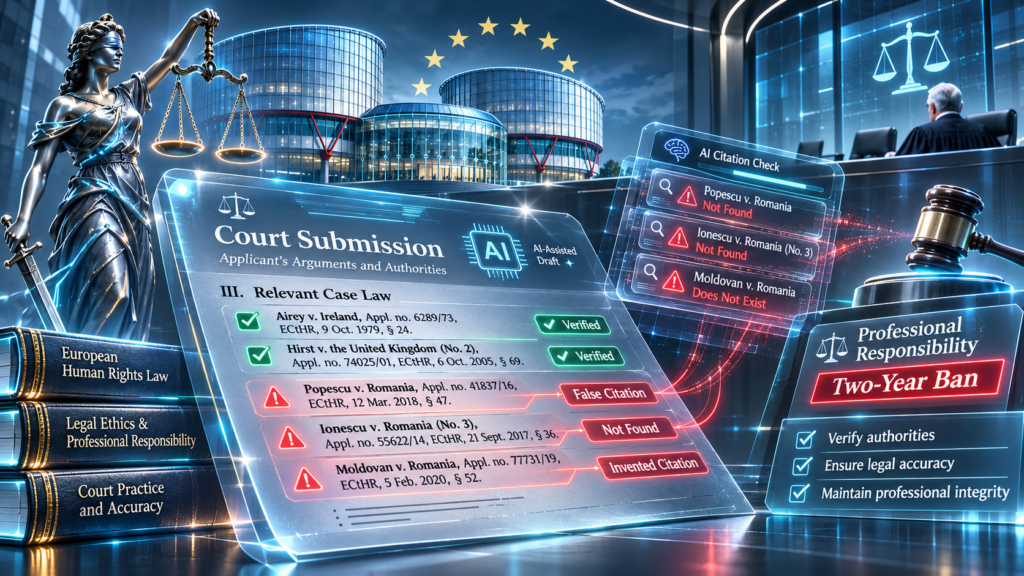
On 13 November 2026, the President of the ECtHR decided to exclude a Romanian lawyer from representing or assisting litigants before the Court for two years. The decision was publicly announced on 18 November 2026.¹
The lawyer had used artificial intelligence to prepare written submissions that contained several types of substantive errors:
- References to court decisions that did not exist.
- Invented passages attributed to genuine judgments.
- References to existing case law that was irrelevant to, or contradicted, her legal arguments.
Although the lawyer acknowledged using AI, the Chamber considered the recurring errors substantially more serious than occasional mistakes in referencing legal authorities.
The Legal Basis: Rule 44D of the Rules of Court
The exclusion was imposed under Rule 44D §§ 1 and 2 of the Rules of Court, which permits the exclusion of legal representatives in exceptional circumstances.
The restriction applies to both pending and future applications before the ECtHR. It does not, however, constitute a general prohibition on practising law in Romania.
The Chamber concluded that the lawyer had failed to meet her professional and ethical obligations. Furthermore, examining the inaccurate submissions and conducting the subsequent exclusion proceedings consumed considerable judicial resources, interfering with the administration of justice.²
New Technology, Existing Professional Duties
Perhaps the most interesting aspect of the decision is that the Court did not need to rely on AI-specific rules.
Instead, the obligation to verify AI-generated material was derived from existing professional duties, including those established under Romanian law and the Court’s own case law.
Legal representatives are responsible for independently verifying AI-generated citations and arguments against reliable legal sources before submitting them. In this particular case, many of the errors could have been identified through a straightforward search of HUDOC, the ECtHR’s official case-law database.³
The underlying principle is therefore not specific to artificial intelligence: regardless of how legal information is obtained, lawyers remain responsible for its accuracy.
Final Thoughts
This decision should not discourage legal professionals from using artificial intelligence. Rather, it should encourage them to integrate AI into their workflows responsibly.
The ability to critically evaluate AI-generated content is becoming an increasingly important professional skill. For law students, trainee lawyers and experienced practitioners alike, technological competence must go hand in hand with legal expertise and professional judgement.
AI can assist lawyers in performing their duties, but it cannot assume responsibility for them.
Ultimately, the question is not whether lawyers should use AI, but whether they have the necessary skills and safeguards to use it responsibly.