

Artificial intelligence (AI) is one of those terms that gets thrown around a lot these days. It´s everywhere – your phone, your favorite streaming service, even in the algorithms deciding what ads you see. But let´s be real: most people don´t fully understand what AI is, where it came from, or what it actually does. If you are nodding along right now, don´t worry – you are not alone. In this article, we are cutting through the jargon and breaking it all down in plain, easy-to-understand terms.
The Origin of AI: From Humble Beginnings to World Domination
To understand what AI is today, we need to rewind a bit. The idea of machines that could “think” or mimic human intelligence isn´t new – it´s been around for centuries. Philosophers as far back as the ancient Greeks toyed with the concept. But it wasn´t until the mid-20th century that AI started to become more than just science fiction.
The Role of Alan Turing: The father of AI
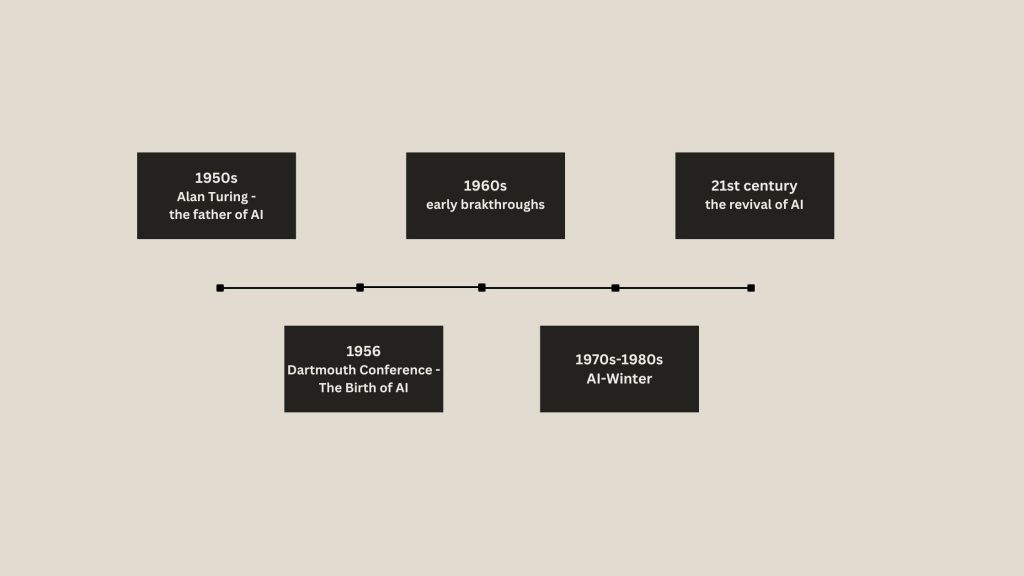
A pivotal figure in the origin of AI is Alan Turing, the British mathematician and computer scientist. In 1950, Turing introduced the concept of machine intelligence in his groundbreaking paper, “Computing Machinery and Intelligence”. He posed a simple yet revolutionary question: Can machines think? To explore this, Turing proposed the famous Turing Test, a method to determine whether a machine can exhibit human like intelligence by engaging in natural conversation indistinguishable from human´s. While modern AI has evolved beyond the Turing Test, his work laid the theoretical foundation for what we now call artificial intelligence.
1950s: The Birth of AI
The term “artificial intelligence” was officially coined in 1956 at a conference at Dartmouth College, led by computer scientist John McCarthy. Back then, the goal of AI was pretty straightforward: create machines that could think and learn like humans. The first attempts were simple – playing games like chess and solving basic mathematical problems.
The Early Breakthroughs
One of the first big moments in AI came in the 1960s, with programs like ELIZA, an early chatbot that could simulate conversations. Sure, it wasn´t perfect – it mostly repeated what you said back to you – but it was a step in the right direction.
The AI Winter
But progress wasn´t smooth. By the 1970s and 1980s, enthusiasm for AI had cooled. Why? Because early AI systems just didn´t live up to the hype. Funding dried up, and it seemed like AI was destined to be a niche topic for researchers rather than a game-changer for humanity.
The Revival
Fast-forward to the 21st century, and AI has made a huge comeback. Thanks to advancements in computing power, data availability, and algorithms, AI is now everywhere – from the smartphone that you use everyday to the systems running self-driving cars.
Artificial Intelligence Explained in Simple Terms
Artificial Intelligence has become the buzzword of the decade. Politicians regulate it, companies market it, and half of LinkedIn suddenly claims to be an “AI strategist.” But beneath the hype lies a surprisingly simple question: what actually is AI?
Artificial Intelligence, usually shortened to AI, refers to computer systems designed to perform tasks that normally require human intelligence. These tasks can include understanding language, recognizing images, making predictions, solving problems, or generating content. AI is not magic, even if some chatbot responses occasionally feel suspiciously close. It is essentially a combination of data, mathematics, and computing power working together at scale.
How AI and Machine Learning Work
Most modern AI systems rely on machine learning. Instead of following fixed instructions, machine learning systems analyze enormous amounts of data and identify patterns on their own. Imagine teaching a child to recognize dogs by showing thousands of pictures. AI learns in a similar way, except much faster and with significantly fewer snack breaks.
The more data an AI system receives, the better it usually becomes at predicting outcomes or generating responses. This is why companies invest heavily in collecting and processing data. In the AI world, data is often compared to oil. Slightly less messy, but arguably more valuable.
The Rise of Generative AI Tools
AI truly entered mainstream culture with the rise of generative AI. Tools like OpenAI’s ChatGPT can create text, images, music, and even videos within seconds. Unlike traditional software, generative AI does not simply retrieve stored information. It creates entirely new content based on patterns learned during training.
This development has transformed industries ranging from marketing and journalism to software development and education. Suddenly, tasks that once took hours can now be completed in minutes. Unsurprisingly, this has triggered both excitement and panic – often at the same time.
Why AI Regulation Matters
Despite the name, AI systems are not actually intelligent in the human sense. They do not understand morality, emotions, or truth. They predict outputs based on probabilities and training data. That distinction becomes important when AI systems are used in sensitive areas like healthcare, hiring, finance, or criminal justice.
This is one reason why governments worldwide have started regulating AI technologies. The EU AI Act is considered the world’s first comprehensive AI law and aims to create rules for transparency, accountability, and safety in AI systems.
Critics argue that regulation could slow innovation, while supporters believe clear rules are necessary to protect fundamental rights. Welcome to modern tech policy: everyone agrees AI is important, but nobody fully agrees on how to control it.
AI in Everyday Life
Ironically, many people already use AI every single day without noticing it. Recommendation systems on Netflix, spam filters in emails, navigation apps, online shopping suggestions, and voice assistants all rely on AI technologies.
Once a technology becomes normal, people often stop calling it AI altogether. Experts even have a term for this phenomenon: the “AI effect.” Apparently, the fastest way to make AI seem less impressive is simply to make it useful.
Final Thoughts
Artificial Intelligence is often presented as either humanity’s greatest invention or its greatest threat. The reality is far less dramatic and far more interesting. AI is ultimately a tool – a powerful one, but still a tool created by humans.
Understanding how AI works is becoming increasingly important, especially for lawyers, businesses, and policymakers navigating a rapidly changing digital world. Because whether people love it, fear it, or simply pretend to understand it during meetings, AI is no longer a futuristic concept. It is already shaping the way we work, communicate, and make decisions every day.
Stay curious, stay informed, and let´s keep exploring the fascinating world of AI together.
This post was written with the help of different AI tools.
Recommended Read and Listen
Disclaimer: The links provided on this blog lead to external websites that are not under my control.
I do not guarantee the accuracy, reliability, or content of these external sites. Visiting these links is at your own discretion and risk.