What Is a Large Language Model?
A Large Language Model is a type of artificial intelligence trained on vast amounts of data to recognise and reproduce patterns in language.
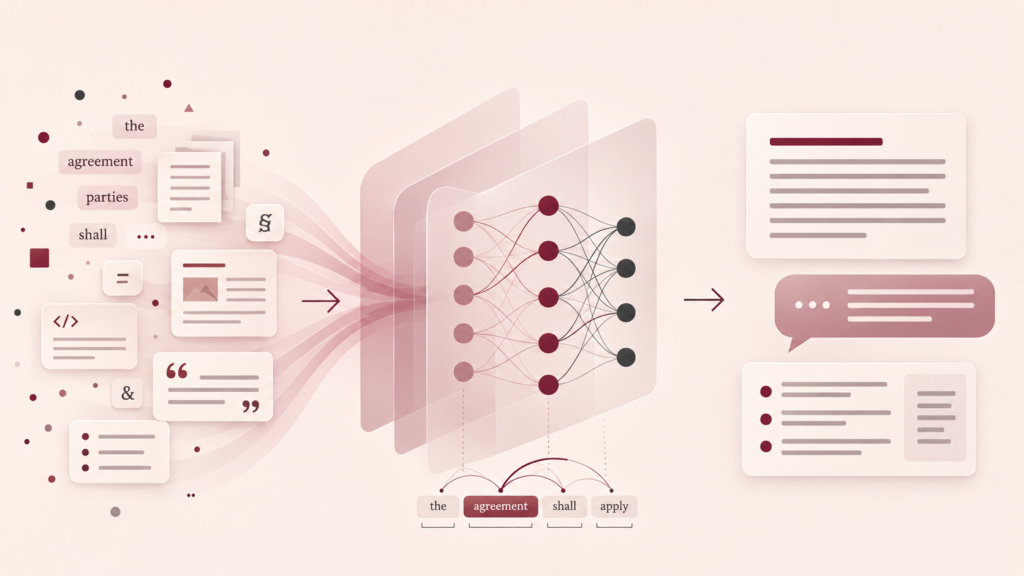
LLMs are built using neural networks, mathematical systems inspired loosely by the structure of the human brain. Through training, they learn relationships between words, sentences and concepts.
This enables them to answer questions, summarise documents, translate languages and generate entirely new text.
ChatGPT is a familiar example, although an important distinction exists: ChatGPT is an AI application powered by language models, rather than a language model itself.
How Do LLMs Actually Work?
At the heart of most modern LLMs lies a neural network architecture called the Transformer, introduced by researchers in 2017. Transformers use a mechanism called attention to identify relationships between different parts of a text. This allows a model to interpret words in context rather than treating each word independently.
Before processing language, the model divides text into smaller units called tokens. These can represent complete words, parts of words or punctuation marks. During training, many generative language models learn to predict the next token in a sequence.
Consider the sentence: „The judge delivered the final…“ Based on patterns learned during training, the model might assign a high probability to the word „judgement“. By repeatedly predicting tokens and adjusting millions or billions of internal parameters, the model becomes increasingly capable of producing coherent language. When a user enters a prompt, the model generates its response token by token, using the surrounding context and its learned parameters.
From Language Prediction to ChatGPT
Predicting text is only part of the process. Modern conversational models typically undergo additional training to follow instructions, respond to questions and produce more useful answers.
Techniques such as supervised fine-tuning and reinforcement learning from human feedback can help align model behaviour with human preferences. Some applications also connect language models to external tools, allowing them to search for information, analyse documents or perform other tasks.
This distinction matters: a language model’s trained knowledge is not the same as retrieving information from a current, verifiable source.
Can Large Language Models Actually Understand?
Despite their capabilities, LLMs have important limitations. They can generate inaccurate or entirely fabricated information, commonly described as hallucinations. Their responses may appear authoritative even when the underlying claims are wrong.
Whether language models genuinely understand meaning remains a subject of scientific and philosophical debate. For legal professionals, this creates a particular challenge. An AI-generated legal argument may sound persuasive while referring to nonexistent cases or misrepresenting established law. Fluent language is not proof of factual accuracy.
Final Thoughts
Large Language Models have changed how we interact with technology. Instead of learning complicated commands, users can communicate with software through ordinary language.
But this accessibility also creates a risk: confusing a convincing answer with a reliable one. Understanding how LLMs generate language is therefore essential, not only for using these tools effectively, but also for recognising when their outputs require independent verification.