What Is an Artificial Neural Network?
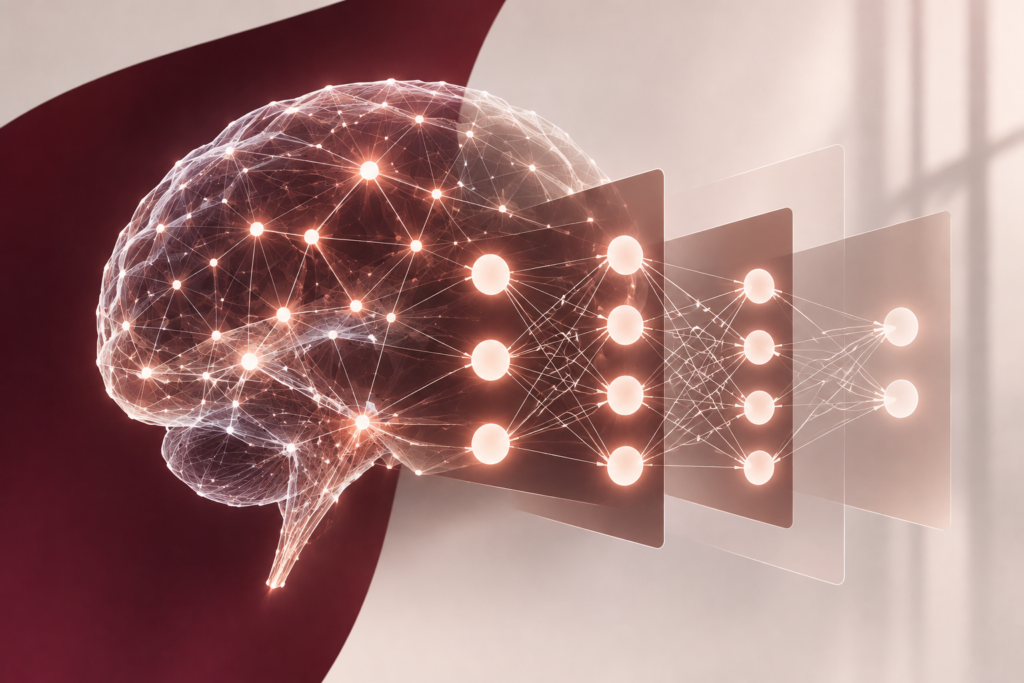
An artificial neural network is a machine learning model made up of interconnected computational units, commonly called artificial neurons. The concept takes inspiration from biological neural networks, where neurons communicate through complex connections. However, artificial neurons are much simpler: they perform mathematical operations rather than biological processes.
Each artificial neuron receives numerical inputs, combines them using adjustable values called weights and typically applies an activation function to produce an output. By connecting many neurons, a network can recognise complex relationships in data that would be difficult to describe through manually programmed rules.
How Do Neural Networks Process Information?
A basic neural network consists of three types of layers. The input layer receives information, such as numerical values representing the pixels of an image. The hidden layers process that information through interconnected neurons. Each connection has a weight that determines how strongly an input influences the next computation. Activation functions allow the network to model complex, non-linear relationships.
Finally, the output layer produces a result, such as a prediction or classification. Imagine teaching a neural network to recognise handwritten numbers. Early layers might respond to simple visual features, while later layers combine information into more complex patterns associated with particular digits. The network does not need a programmer to define every relevant visual characteristic. Instead, it develops useful representations through training.
How Do Neural Networks Learn?
Initially, a neural network’s predictions may be largely inaccurate because its parameters have not yet been optimised. During training, the network processes examples and produces predictions. A mathematical function, known as the loss function, measures how well those predictions match the training objective. An algorithm called backpropagation then calculates how changes to the network’s parameters would affect that loss.
An optimisation method, commonly gradient descent, uses this information to adjust the weights and reduce errors. Repeated across many training examples, this process gradually improves the network’s performance. When a neural network contains multiple hidden layers, it is generally described as a deep neural network. This approach forms the basis of deep learning.
Why Are Neural Networks So Powerful and So Difficult to Explain?
Neural networks can identify intricate patterns in images, language and other data. Modern architectures, including Transformers, enable increasingly sophisticated applications such as generative AI.
However, their complexity introduces challenges. A network may contain millions or billions of adjustable parameters, making it difficult to explain precisely why a particular output was produced. Its predictions can also reflect biases in training data or fail when confronted with unfamiliar situations. These limitations become particularly significant when neural networks influence decisions in healthcare, recruitment or the legal system.
Final Thoughts
Artificial neural networks demonstrate how relatively simple mathematical operations can produce remarkably complex behaviour when combined at scale. Yet their resemblance to the human brain should not be overstated. Neural networks process numerical information; they are not miniature digital brains.
Understanding this distinction matters because the increasing sophistication of AI systems does not eliminate their limitations. It makes understanding, evaluating and questioning their outputs even more important.