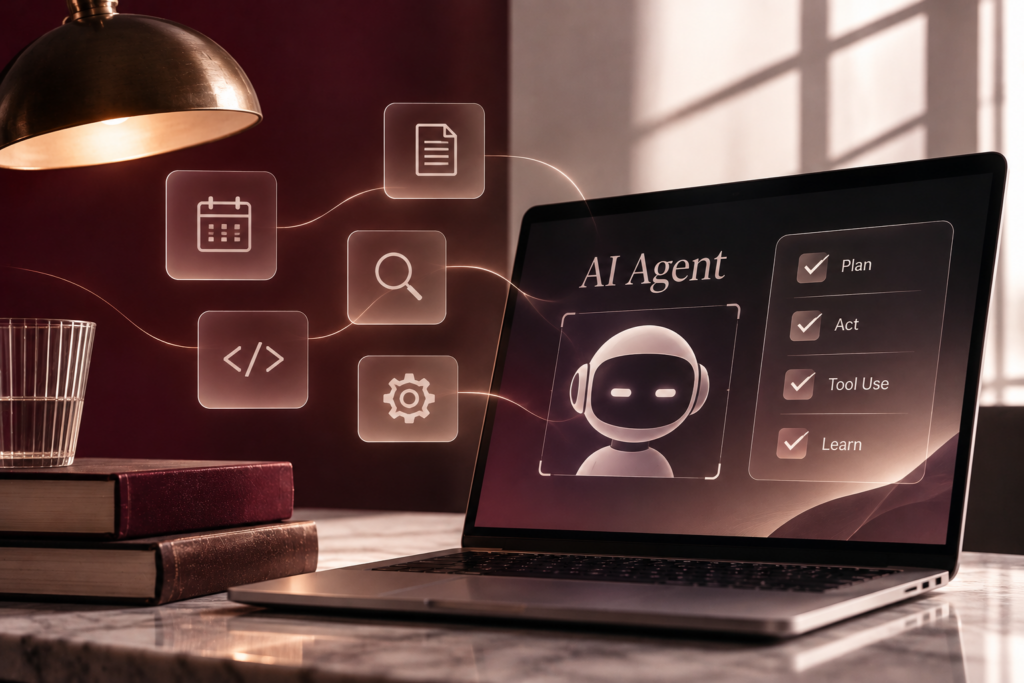
What Is an AI Agent?
An AI agent is a software system designed to pursue goals and carry out tasks with a degree of autonomy. Unlike a conventional chatbot that primarily responds to individual questions, an AI agent can determine which steps are necessary to complete a task and, within its permitted capabilities, execute them.
Many modern agents are powered by Large Language Models (LLMs), which interpret instructions and help determine what to do next. However, the language model is only one component of the system. What makes an AI agent particularly useful is its ability to combine language processing with planning, tool use and action.
Chatbots vs AI Agents: What's the Difference?
A traditional AI chatbot operates primarily through conversation. Users provide prompts, and the system generates responses based on its instructions and available information. An AI agent goes further by working towards a defined objective.
Consider a legal professional preparing for a client meeting. A chatbot might summarise a document or explain a legal provision. An appropriately configured AI agent could potentially retrieve relevant documents, identify important deadlines, search authorised databases and prepare a meeting briefing.
The distinction is not necessarily the interface. Both systems may communicate through a chat window. What matters is whether the system can independently coordinate and perform actions beyond generating responses. The boundary is also becoming less clear as modern chatbots increasingly incorporate agent-like capabilities.
How Do AI Agents Actually Work?
Most LLM-powered agents combine three essential components: an AI model, instructions and access to external tools. The model interprets the user’s objective and helps select the next steps. Instructions define its responsibilities and limitations, while tools allow it to interact with external systems, such as calendars, databases or websites. An agent might first gather information, evaluate the results and decide whether additional actions are necessary.
This creates an iterative process: plan, act, observe and adjust. Importantly, autonomy does not mean unlimited independence. Agents can operate within predefined permissions, require approval for sensitive actions and return control to users when necessary.
The Risks of Giving AI the Ability to Act
The ability to perform actions introduces risks beyond those associated with generating incorrect text. An AI agent might misinterpret instructions, access inappropriate information or execute an unintended action. Malicious instructions embedded in external content can also manipulate its behaviour through prompt injection.
These concerns become particularly significant in legal practice, where confidentiality, accuracy and professional responsibility are essential. Human oversight, restricted permissions and reliable verification mechanisms therefore remain crucial.
Final Thoughts
AI agents represent a shift from systems that primarily provide information towards systems capable of acting on it.
Their significance lies not simply in greater automation, but in the possibility of delegating increasingly complex processes to software. Yet the more responsibility an AI system assumes, the more important its boundaries become. The challenge is no longer just determining what AI can do, but deciding what it should be allowed to do independently.