What Is Multimodal AI?
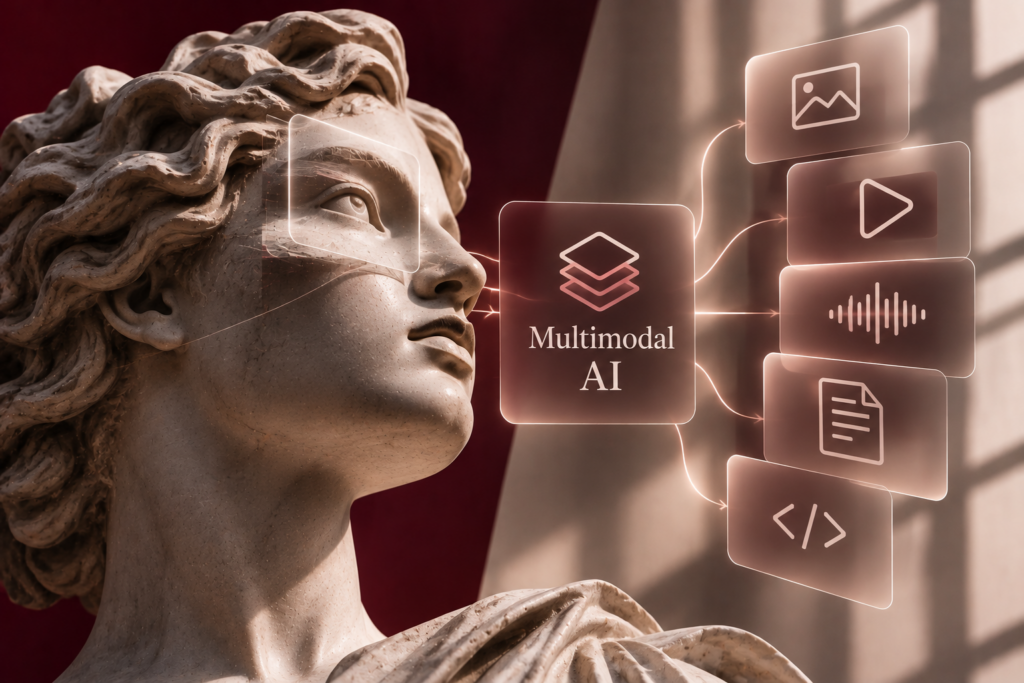
Multimodal artificial intelligence refers to AI systems capable of processing or generating information across multiple types of data, known as modalities.
These include text, images, audio, video and, in some applications, other forms of sensory information.
Traditional text-based language models primarily work with written language. Multimodal systems, by contrast, can combine different inputs or produce outputs in different formats.
For example, a multimodal AI assistant might analyse an image, interpret a spoken question about it and respond verbally.
The defining characteristic is not simply handling different file formats, but connecting information across modalities.
How Does Multimodal AI Actually Work?
Computers cannot directly interpret images, speech or written language as humans do. Instead, AI models process numerical representations of these inputs.
Text can be divided into tokens, while images are represented through visual features derived from pixels. Audio signals and video sequences require their own processing methods.Neural networks transform this information into mathematical representations that the system can analyse.
The crucial step is multimodal integration, sometimes called fusion.Depending on the architecture, specialised components may process different modalities before combining their representations. Other systems are trained to process several modalities within a unified neural network.Through training, models learn relationships between different forms of information.
For instance, they can learn to associate the written word „dog“ with images of dogs or the sound of barking.This allows multimodal systems to perform tasks that require connecting visual, linguistic and auditory information.
From Images to Real-Time Conversations
Multimodal AI has expanded the capabilities of generative artificial intelligence.
Systems such as Google’s Gemini and OpenAI’s GPT-4o have demonstrated the ability to process combinations of text, images, audio and video.
This enables applications ranging from describing photographs and interpreting charts to analysing video sequences and participating in spoken conversations.
Consider a legal professional reviewing a scanned contract. A multimodal system could potentially examine the document’s visual layout, identify relevant passages and answer questions about its contents.
However, the ability to process several modalities does not guarantee that the information will be interpreted correctly.
What Are the Limitations of Multimodal AI?
Combining different data types introduces additional challenges.
A model may misread text in an image, misunderstand spoken instructions or overlook important details in a video. Multimodal systems can also generate hallucinations, producing convincing descriptions that do not accurately reflect the original material.
Processing photographs, recordings and other potentially sensitive information raises further concerns about privacy, consent and data security. These risks become particularly relevant when AI is used to analyse medical records, legal evidence or confidential documents.
Final Thoughts
Multimodal AI changes how we interact with technology by moving beyond written instructions towards communication involving images, speech and movement.
Yet processing information through multiple channels is not the same as experiencing or understanding the world as humans do.As AI systems become increasingly capable of interpreting complex environments, the central question remains whether their outputs can be trusted — and how we can verify what they claim to have recognised.